ANCIENT GREEKS: 1, HUMANOIDS: 0
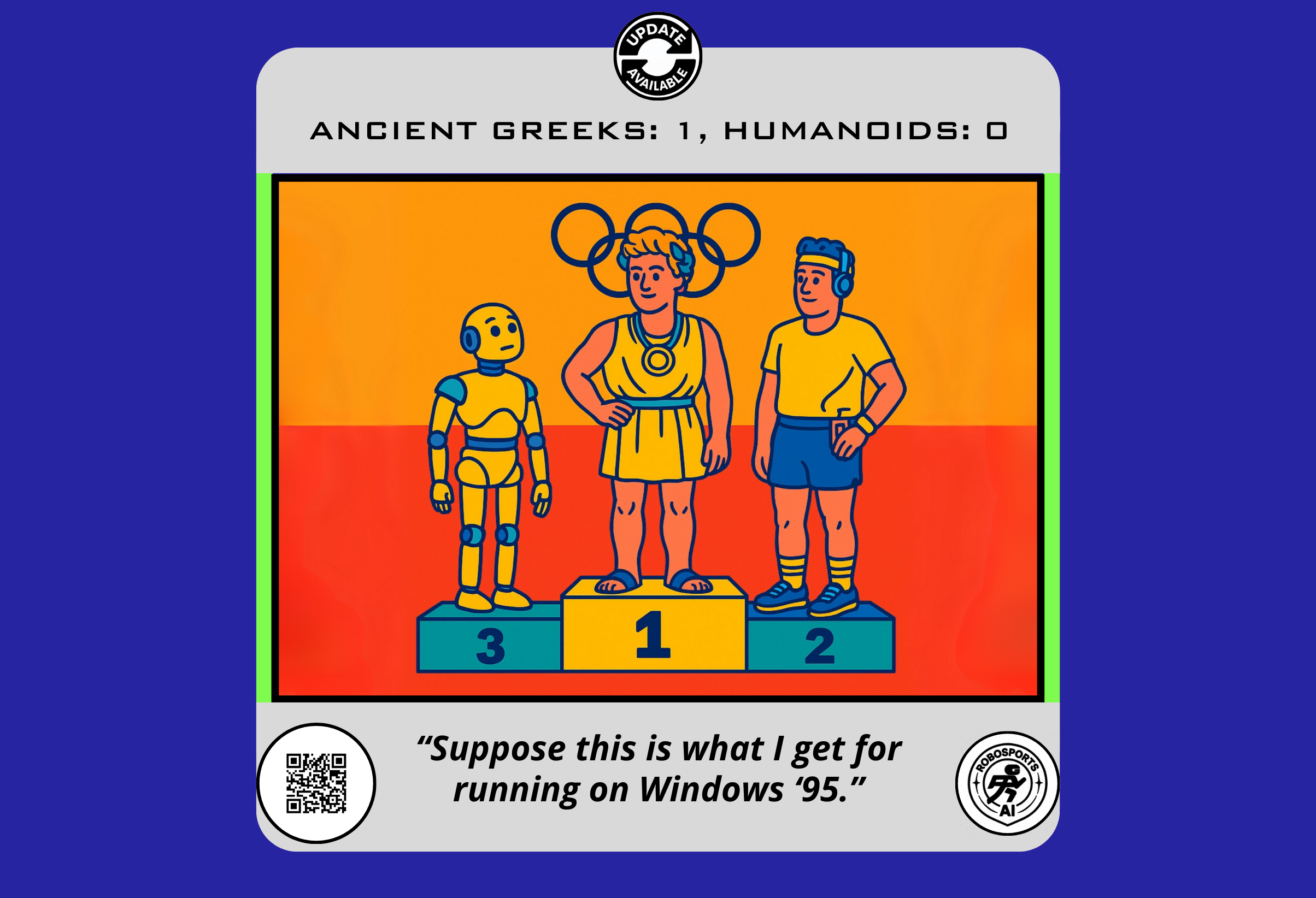
TL;DR — Humanoid robots held their first "International Humanoid Olympiad" at Ancient Olympia, Greece, playing soccer and boxing while occasionally freezing for battery changes. Impressive spectacle, yes — but also a reality check about how far behind physical AI lags compared to ChatGPT-style intelligence.
The news — According to AP News, robots demonstrated athletic skills including soccer, shadow-boxing, and archery at the birthplace of the Olympic Games, though they "shuffled and occasionally froze for a battery change" during competitions.
Why it matters —
Physical vs. digital gap: While AI has exploded in text applications like ChatGPT, humanoid robots are "lagging years behind" their digital cousins.
Data scarcity problem: Training material for humanoid robots involves "real-world actions that are slower, more expensive and harder to record than digital data like text or images."
National competition emerging: Chinese companies increasingly showcase robots at public events like Beijing's Humanoid Robot Games, while U.S. companies "mostly stick to polished videos that can mask failures."
Between the lines —
Reality vs. hype: Several U.S. roboticists came to Greece to speak, "but few brought robots" — suggesting the tech isn't ready for prime time.
Failure as feature: When Boston Dynamics' robots performed on "America's Got Talent," one broke down mid-routine, but judge Simon Cowell noted it was "weirdly better" because "it showed how difficult this was."
Space before homes: Experts believe "humanoids will first go to space and then to houses" — it'll take "more than 10 years" before they can execute household tasks with dexterity.
By the numbers — According to Science Robotics journal, humanlike robots are roughly 100,000 years behind AI in learning from data — a staggering gap that highlights why your Roomba still bumps into furniture while ChatGPT writes poetry.
What's next —
Real-world training: UC Berkeley's Ken Goldberg urges makers to move beyond simulations and let robots "collect data as they perform useful work, such as driving taxis and sorting packages."
Bio-computing breakthrough: Companies like Cortical Labs are developing biological computers using "real brain cells grown on a chip" that can learn and adapt more like humans.
Cross-pollination advantage: Prosthetics data from human users could "accelerate robot development" by bridging the gap between human and robotic applications.
What to watch — Will robotics companies start prioritizing embarrassing public demos over slick marketing videos — and will the data they generate actually close that 100,000-year learning gap, or just create more viral robot fail compilations?